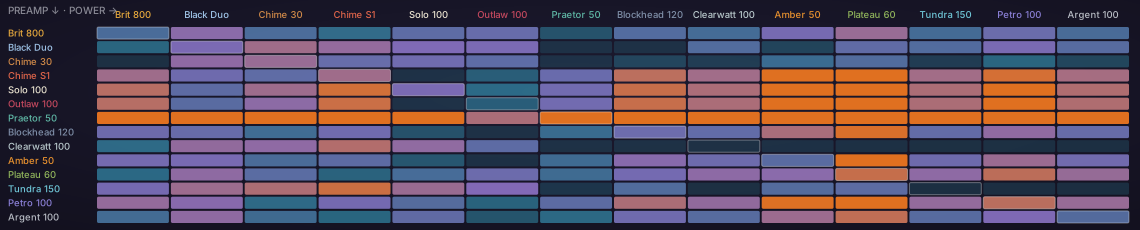
Pick a model in the Amp module. Each one runs at a Quality setting you choose, trading CPU for detail, and switches in the background while the current model keeps playing.

The classic hot-rodded British master-volume head.
In Amp Lab
Preamp: The hot-rodded British head's cascade; Feed acts on its gain cell.
Power: The British master-volume head's power section, with presence feedback. Runs a flat loadbox - pair with the Cabinet module.

The clean American combo. Master full up is the stock sound (the original has no master).
In Amp Lab
Preamp: The clean American combo's front end.
Power: The clean American combo's power section. Runs a flat loadbox - pair with the Cabinet module.

The British class-A chime machine. Presence acts as its backwards Tone Cut (up = darker); Mid is not in this circuit.
In Amp Lab
Preamp: The class-A chime machine's front end. Mid is not in this circuit.
Power: The class-A chime power section. Presence acts as its backwards Tone Cut (up = darker); supply sag is built in and always on. Runs a flat loadbox - pair with the Cabinet module.

The modern single-channel take on the chime machine (hybrid FET front end, crossline Master). Runs into its own alnico speaker load; Mid and Presence are not in this circuit.
In Amp Lab
Preamp: The modern chime's hybrid FET front end. Mid is not in this circuit; Squash and Rails have no effect.
Power: The modern chime's power section - no feedback loop (no Presence). Runs into its own alnico speaker load.

The hot-rodded American 100 W lead head - cascaded gain into a tube FX loop and a tight high-feedback 6L6 power section.
In Amp Lab
Preamp: The American lead head's cascaded high-gain front end, with the Overdrive/Crunch/Clean Channel switch - the deepest circuit (most CPU).
Power: The tight high-feedback power section, with Depth as well as Presence. Runs a flat loadbox - pair with the Cabinet module.
- Channel
- Bright
- Depth
- Presence

The modern American high-gain EL34 head - three modes (Crush/Crunch/Clean) on the Channel switch, a very cold-biased power section, and the Watts and Variac power switches. CPU cost is in the Solo 100 class.
In Amp Lab
Preamp: The modern American high-gain EL34 head's front end - three modes (Crush/Crunch/Clean) on the Channel switch. CPU cost is in the Solo 100 class.
Power: The very cold-biased EL34 power section (100W Bold - its native operating point), with its channel master on the Master knob. Runs a flat loadbox - pair with the Cabinet module.

The modern American 50 W two-channel head - a dense cascaded Lead channel with true stage-to-stage dynamics (attack bloom and blocking recovery), a chimey Clean channel, and Depth plus Bright on both. The cheapest of the high-gain models to run.
In Amp Lab
Preamp: The modern American 50 W head's two-channel front end - a dense cascaded Lead with true stage-to-stage dynamics, and a chimey Clean, on the Channel switch. The cheapest of the high-gain models to run.
Power: The 50 W fat-bottle power section, with Depth as well as Presence. Its own speaker-load resonance is built in, so it is voiced rather than flat - pair with the Cabinet module.

The American 120 W metal head - a very cold-biased 6L6 power section behind a six-stage preamp built around one cold unbypassed clipper. Three positions on the Channel switch (Lead/Crunch/Rhythm); Bright and Depth belong to the Crunch and Rhythm side, and Depth is its Resonance control.
In Amp Lab
Preamp: The block-letter 120 W head's six-stage cascade - Lead, Crunch and Rhythm on the Channel switch, Bright on the two rhythm voicings. CPU cost is in the Solo 100 class.
Power: The 120 W quad-6L6 power section, with Resonance (on the Depth knob) as well as Presence. Runs a flat loadbox - pair with the Cabinet module.

The British 100 W clean-headroom head - two front-end voicings, Normal and Brilliant, that the Channel switch runs alone or summed (Linked), into a stiff quad-EL34 power section that stays clean until it is cranked. No Bright, no Depth.
In Amp Lab
Preamp: The British hi-fi head's clean, loud front end - Normal, Brilliant or both Linked (jumpered and summed) on the Channel switch, with Mid and the drawn master in its tone stack. No Bright.
Power: The 100 W quad-EL34 power section on a stiff supply - no sag, no Depth - with Presence as the amount of its treble cut. Runs a flat loadbox - pair with the Cabinet module.

The British 50 W two-channel head - a thick Dirty channel with two cascaded gain pots on one Drive knob and a plate-fed Clean channel, into a cold-biased quad-6V6 power section. No Presence, no Bright, no Depth.
In Amp Lab
Preamp: The British 50 W two-channel front end - a thick Dirty channel with two cascaded gain pots on one Gain knob (Master is its channel volume), and a plate-fed Clean channel (Gain is its volume; no Mid on this channel). No Bright.
Power: The cold-biased quad-6V6 50 W power section on a stiff supply - no sag, no Depth, and no Presence control (its feedback is fixed). Runs a flat loadbox - pair with the Cabinet module.

The American cascaded-gain lead head - one four-stage preamp with two volumes: Lead puts Drive on the second (the lead gain), Rhythm on the first, with a five-band graphic EQ after the Master, into a 6L6 power section with Presence. Bright switch on both. No Depth.
In Amp Lab
Preamp: The American cascaded-gain lead front end - Lead puts Gain on the second volume (the lead gain), Rhythm on the first, on the Channel switch; Master is its master volume and Bright its switch on both. The graphic EQ stays flat here.
Power: The 6L6 quad power section on a stiff supply (its 100 W mode) - no sag, no Depth - with Presence on its feedback. Runs a flat loadbox - pair with the Cabinet module.

The American 150 W doom head - two front-end voicings, Normal and Brite, that the Channel switch runs summed (Both, the way the amp is known) or alone, through a cathode-follower tone stack into a stiff quad-6550 power section with Presence. No Bright, no Depth.
In Amp Lab
Preamp: The big American clean-and-loud front end - Both (its signature: the Normal and Brite inputs driven together and summed), Normal or Brite alone on the Channel switch, with Mid and the drawn master volume in its tone stack. No Bright.
Power: The big fixed-bias quad power section on a stiff supply - no sag, no Depth - with Presence on its feedback. The cleanest and stiffest of the power blocks. Runs a flat loadbox - pair with the Cabinet module.

The German 100 W four-channel head - Lead, Mega, Crunch and Clean all run into one shared output stage and one tone stack, so the channels differ by how hard they drive the same pair rather than by where they clip. Tight, dark and enormous at the bottom, with Presence and Depth on the feedback loop. No Bright.
In Amp Lab
Preamp: The German four-channel head's front end - Lead, Mega, Crunch or Clean on the Channel switch, all driving one shared cathode follower and tone stack, so the channels differ by how hard they hit the same stage rather than by where they clip; Master is its master volume. No Bright.
Power: The German 100 W quad power section on a stiff supply - no sag - with Presence and Depth (its Deep control) as two legs of one feedback network, so each shades the other. Runs a flat loadbox - pair with the Cabinet module.

The British 100 W silver-panel head - one preamp chain with a three-way Channel switch: Lead drops a diode clip node behind the third stage and adds its own Lead Master, Rhythm Clip engages a gentler clip node, Rhythm runs the chain open. Watts switches the output quad between full pentode (100) and triode (50). Presence and Mid live; no Bright, no Depth.
In Amp Lab
Preamp: The British silver-panel head's front end - Lead, Rhythm Clip or Rhythm on the Channel switch, the two clip channels running the tube cascade into a diode clamp (an LED pair on Lead, silicon on Rhythm Clip) rather than into another tube; Gain is its input gain and Master its master volume, with its Lead Master held at its home position. No Bright.
Power: The British silver-panel quad-EL34 power section on a stiff supply (its 100 W pentode mode) - no sag, no Depth - with Presence on a feedback loop taken from the low-impedance speaker tap. Runs a flat loadbox - pair with the Cabinet module.